Roads to Madness Lord of the Rings Art Drawings
| Gandalf | |
|---|---|
| Tolkien grapheme | |
| First advent | The Hobbit (1937) |
| Last appearance | Unfinished Tales (1980) |
| In-universe data | |
| Aliases | See Names |
| Race | Maia |
| Affiliation | Company of the Band |
| Weapon |
|
Gandalf is a protagonist in J. R. R. Tolkien's novels The Hobbit and The Lord of the Rings. He is a sorcerer, one of the Istari club, and the leader and mentor of the Fellowship of the Ring. Tolkien took the name "Gandalf" from the Old Norse "Catalogue of Dwarves" (Dvergatal) in the Völuspá.
As a wizard and the bearer of ane of the Three Rings, Gandalf has great ability, only works mostly by encouraging and persuading. He sets out equally Gandalf the Grey, possessing great noesis, and travelling continually, ever focused on the mission to counter the Dark Lord Sauron. He is associated with fire, his ring being Narya, the Ring of Burn down, and he both delights in fireworks to entertain the hobbits of the Shire, and in swell demand uses fire as a weapon. Equally one of the Maiar he is an immortal spirit, simply existence in a physical body on Center-earth, he can be killed in battle, equally he is by the Balrog from Moria. He is sent back to Middle-world to complete his mission, at present as Gandalf the White and leader of the order of wizards.
Tolkien once described Gandalf every bit an angel incarnate; later, both he and other scholars have likened Gandalf to the Norse god Odin in his "Wanderer" guise. Others have described Gandalf as a guide-figure who assists the protagonist, comparable to the Cumaean Sibyl who assisted Aeneas in Virgil's The Aeneid, or to Virgil himself in Dante's Inferno; and as a Christ-figure, a prophet.
Names [edit]

Etymology [edit]
Tolkien derived the name Gandalf from Gandálfr, a dwarf in the Völuspá's Dvergatal, a listing of dwarf-names.[1] In Erstwhile Norse, the name means staff-elf. This is reflected in his name Tharkûn, which is "said to hateful 'Staff-human being'" in Khuzdul, one of Tolkien's invented languages.[T 1]
In-universe names [edit]
Gandalf is given several names and nicknames in Tolkien'due south writings. Faramir calls him the Grayness Pilgrim, and reports Gandalf as saying, "Many are my names in many countries. Mithrandir [a] amongst the Elves, Tharkûn to the Dwarves, Olórin I was in my youth in the West that is forgotten, in the S Incánus, in the Due north Gandalf; to the E I get non."[T 2]
In an early manuscript version of The Hobbit, he is chosen Bladorthin.[2] The name Gandalf is used by the dwarf who subsequently became Thorin Oakenshield.
Each Wizard is distinguished by the colour of his cloak. For most of his manifestation equally a magician, Gandalf's cloak is greyness, hence the names Gandalf the Grey, and Greyhame, from Quondam English hame, "cover, skin". Mithrandir is a name in Sindarin meaning "the Grey Pilgrim" or "the Grey Wanderer". Midway through The Lord of the Rings, Gandalf becomes the head of the guild of Wizards, and is renamed Gandalf the White. This change in status (and clothing) introduces another name for the wizard: the White Rider. Still, characters who speak Elvish yet refer to him as Mithrandir. At times in The Lord of the Rings, other characters address Gandalf by insulting nicknames: Stormcrow, Láthspell ("Sick-news" in Erstwhile English language), and "Grey Fool".[T 1]
Characteristics [edit]
Tolkien describes Gandalf equally the last of the wizards to appear in Centre-globe, i who "seemed the to the lowest degree, less tall than the others, and in looks more aged, gray-haired and gray-clad, and leaning on a staff".[T ane] Notwithstanding the Elf Círdan who met him on arrival nonetheless considered him "the greatest spirit and the wisest" and gave him the Elven Ring of Power chosen Narya, the Band of Burn down, containing a "red" stone for his aid and comfort. Tolkien explicitly links Gandalf to the element burn afterward in the same essay:[T 1]
Warm and eager was his spirit (and information technology was enhanced by the ring Narya), for he was the Enemy of Sauron, opposing the fire that devours and wastes with the fire that kindles, and succours in wanhope and distress; merely his joy, and his swift wrath, were veiled in garments grey every bit ash, and so that only those that knew him well glimpsed the flame that was within. Merry he could exist, and kindly to the immature and unproblematic, still quick at times to sharp speech communication and the rebuking of folly; but he was not proud, and sought neither power nor praise ... By and large he journeyed tirelessly on human foot, leaning on a staff, and then he was called amid Men of the North Gandalf 'the Elf of the Wand'. For they deemed him (though in mistake) to be of Elven-kind, since he would at times piece of work wonders amid them, loving specially the beauty of fire; and yet such marvels he wrought by and large for mirth and delight, and desired not that any should hold him in awe or take his counsels out of fear. ... Yet it is said that in the ending of the job for which he came he suffered greatly, and was slain, and being sent dorsum from expiry for a brief while was clothed then in white, and became a radiant flame (even so veiled yet relieve in great need).[T i]
Fictional biography [edit]
Valinor [edit]
In Valinor, Gandalf was called Olórin.[T i] He was one of the Maiar of Valinor, specifically, of the people of the Vala Manwë; and was said to exist the wisest of the Maiar. He was also closely associated with ii other Valar: Irmo, in whose gardens he lived, and Nienna, the patron of mercy, who gave him tutelage. When the Valar decided to ship the gild of the Wizards (Istari) across the Swell Bounding main to Middle-earth in order to counsel and assist all those who opposed Sauron, Olórin was proposed by Manwë. Olórin initially begged to be excused equally he feared Sauron and lacked the strength to face him, simply Manwë replied that that was all the more reason for him to become.[T 1]
As i of the Maiar, Gandalf was not a mortal Man but an celestial beingness who had taken human grade. As 1 of those spirits, Olórin was in service to the Creator (Eru Ilúvatar) and the Creator'due south 'Clandestine Burn'. Along with the other Maiar who entered into the world as the 5 Wizards, he took on the specific course of an aged former human as a sign of his humility. The office of the wizards was to propose and counsel but never to effort to match Sauron'south strength with their own, and hopefully the kings and lords of Middle-earth would be more receptive to the advice of a humble old human than a more glorious class giving them direct commands.[T 1]
Eye-globe [edit]
The wizards arrived in Center-world separately, early in the 3rd Age; Gandalf was the last, landing in the Havens of Mithlond. He seemed the oldest and least in stature, but Círdan the Shipwright felt that he was the greatest on their beginning coming together in the Havens, and gave him Narya, the Band of Fire. Saruman, the chief Magician, learned of the gift and resented it. Gandalf hid the ring well, and it was not widely known until he left with the other ring-bearers at the end of the Third Historic period that he, and not Círdan, was the holder of the tertiary of the Elven-rings.[T 1]
Gandalf's relationship with Saruman, the head of their Order, was strained. The Wizards were commanded to aid Men, Elves, and Dwarves, but only through counsel; it was forbidden to employ force to dominate them—an injunction that Saruman increasingly disregarded.[T 1]
The White Council [edit]
Gandalf suspected early that an evil presence, the Necromancer of Dol Guldur, was not a Nazgûl merely Sauron himself. He went to Dol Guldur[T iii] to find the truth, but the Necromancer withdrew before him. The Necromancer returned to Dol Guldur with greater force,[T three] and the White Council was formed in response.[T 3] Galadriel had hoped Gandalf would atomic number 82 the quango, just he refused, declining to be bound by whatever but the Valar who had sent him. Saruman was chosen instead, equally the most knowledgeable near Sauron's work in the Second Age.[T iv] [T 1]
Gandalf returned to Dol Guldur "at slap-up peril" and learned that the Necromancer was indeed Sauron returned. The post-obit year the White Quango was summoned, and Gandalf urged that Sauron be driven out.[T 3] Saruman, however, reassured the Council that Sauron's evident try to discover the 1 Ring would fail, every bit the Ring would long since accept been carried by the river Anduin to the Sea; and the affair was allowed to rest. But at this time, Saruman himself began actively seeking the Band well-nigh the Gladden Fields where Isildur had been killed.[T 4] [T i]
The Quest of Erebor [edit]
"The Quest of Erebor" in Unfinished Tales elaborates upon the story backside The Hobbit. It tells of a chance meeting between Gandalf and Thorin Oakenshield, a Dwarf-king in exile, in the inn of the Prancing Pony in Bree. Gandalf had for some time foreseen the coming war with Sauron, and knew that the North was especially vulnerable. If Rivendell were to exist attacked, the dragon Smaug could cause great devastation. He persuaded Thorin that he could help him regain his lost territory of Erebor from Smaug, and so the quest was born.[3]
The Hobbit [edit]
Gandalf meets with Bilbo in the opening of The Hobbit. He arranges for a tea party, to which he as well invites the thirteen dwarves and thus arranges the traveling group central to the novel'south narrative. Gandalf contributes the map and fundamental to Erebor to assist the quest.[T five] On this quest Gandalf finds his sword, Glamdring, in a troll'due south treasure hoard.[iv] Elrond informs them this sword was made in Gondolin, a city where Elrond's father lived as a child before its destruction.[T vi]
Afterward escaping from the Misty Mountains pursued by goblins and wargs, the party is carried to condom by the Great Eagles.[T 7] Gandalf and so persuades Beorn to house and provision the company for the trip through Mirkwood. Gandalf leaves the company earlier they enter Mirkwood, proverb that he had pressing business to attend to.[T viii]
He turns up again, withal, before the walls of Erebor disguised as an old man, revealing himself when it seems the Men of Esgaroth and the Mirkwood Elves volition fight Thorin and the dwarves over Smaug's treasure. The Boxing of Five Armies ensues when hosts of goblins and wargs attack all 3 parties.[T 9] After the battle, Gandalf accompanies Bilbo back to the Shire, revealing at Rivendell what his pressing business had been: Gandalf had once again urged the council to evict Sauron, since quite evidently Sauron did non crave the One Ring to continue to attract evil to Mirkwood.[T 10] And then the Quango "put forth its power" and drives Sauron from Dol Guldur. Sauron, all the same, has predictable this and withdraws equally a feint, only to reappear in Mordor.[T xi]
The Lord of the Rings [edit]
Gandalf the Grey [edit]
As explained in The Fellowship of the Ring, Gandalf spends the years between The Hobbit and The Lord of the Rings traveling Middle-earth in search of data on Sauron's resurgence and Bilbo Baggins'southward mysterious band, spurred specially by Bilbo's initial misleading story of how he had obtained it as a "present" from Gollum. During this period, he befriends Aragorn and beginning becomes suspicious of Saruman. He spends as much fourth dimension as he can in the Shire, strengthening his friendship with Bilbo and Frodo, Bilbo's orphaned cousin and adopted heir.[T 11]
Gandalf returns to the Shire for Bilbo's "eleventy-first" (111th) birthday party, bringing many fireworks for the occasion. Later on Bilbo, every bit a prank on his guests, puts on the Ring and disappears, Gandalf strongly encourages his former friend to leave the ring to Frodo, as they had planned. Bilbo becomes hostile and accuses Gandalf of trying to steal the band. Alarmed, Gandalf impresses on Bilbo the foolishness of this allegation. Coming to his senses, Bilbo admits that the band has been troubling him, and leaves it behind for Frodo equally he departs for Rivendell.[T 12]
Over the next 17 years, Gandalf travels extensively, searching for answers on the band. He finds some answers in Isildur'south scroll, in the archives of Minas Tirith. He as well wants to question Gollum, who had borne the ring for many years. Gandalf searches long and hard for Gollum, and frequently has the help of Aragorn. Aragorn eventually succeeds in finding Gollum. Gandalf questions Gollum, threatening him with burn when he proves unwilling to speak. Gandalf learns that Sauron has forced Gollum nether torture in Barad-dûr to tell what he knows of the ring. This reinforces Gandalf's growing suspicion that Bilbo's ring is the One Ring.[T eleven]
Returning to the Shire, Gandalf confirms his suspicions by throwing the Band into Frodo's hearth-fire and reading the writing that appears on the Ring'southward surface. He tells Frodo the history of the Ring, and urges him to take it to Rivendell, for he will be in grave danger if he stays in the Shire. Gandalf says he will endeavour to render for Frodo's 50th birthday political party, to back-trail him on the road; and that meanwhile Frodo should arrange to exit quietly, equally the servants of Sauron will exist searching for him.[T 13]
Exterior the Shire, Gandalf encounters Radagast the Brown, some other sorcerer, who brings the news that the Nazgûl have ridden forth out of Mordor—and a request from Saruman that Gandalf come to Isengard. Gandalf leaves a letter of the alphabet to Frodo (urging his immediate departure) with Barliman Butterbur at an inn in Bree, and heads towards Isengard. There Saruman reveals his truthful intentions, urging Gandalf to assist him obtain the Ring for his ain use. Gandalf refuses, and Saruman imprisons him at the top of his belfry. Eventually Gandalf is rescued by Gwaihir the Eagle.[T 11]
Gwaihir sets Gandalf downwards in Rohan, where Gandalf appeals to King Théoden for a horse. Théoden, nether the evil influence of Gríma Wormtongue, Saruman'due south spy and servant, tells Gandalf to take any horse he pleases, just to leave quickly. It is and then that Gandalf meets the great horse Shadowfax, one of the mearas, who will exist his mount and companion for much of the Lord of the Rings. Gandalf so rides difficult for the Shire, only does non accomplish information technology until Frodo has already set out. Knowing that Frodo and his companions will be heading for Rivendell, Gandalf makes his own way there. He learns at Bree that the Hobbits have fallen in with Aragorn. He faces the Nazgûl at Weathertop but escapes after an all-night boxing, drawing 4 of them due north.[T 11] Frodo, Aragorn and company confront the remaining five on Weathertop a few nights subsequently.[T 14] Gandalf reaches Rivendell merely before Frodo'south arrival.[T 11]
In Rivendell, Gandalf helps Elrond drive off the Nazgûl pursuing Frodo and plays a corking part in the following council as the only person who knows the full history of the Ring. He also reveals that Saruman has betrayed them and is in league with Sauron. When it is decided that the Ring has to be destroyed, Gandalf volunteers to accompany Frodo—at present the Ring-bearer—in his quest. He also persuades Elrond to let Frodo's cousins Merry and Pippin bring together the Fellowship.[T 11]
The Balrog reached the bridge. Gandalf stood in the centre of the span, leaning on the staff in his left mitt, but in his other mitt Glamdring gleamed, cold and white. His enemy halted again, facing him, and the shadow about it reached out like two vast wings. It raised the whip, and the thongs whined and cracked. Fire came from its nostrils. But Gandalf stood house. "You cannot pass," he said. The orcs stood still, and a dead silence fell. "I am a servant of the Secret Burn down, wielder of the flame of Anor. You cannot laissez passer. The dark burn down will not avail you, flame of Udûn. Go dorsum to the Shadow! Y'all cannot pass."
J. R. R. Tolkien, The Fellowship of the Ring
Taking charge of the Fellowship (comprising ix representatives of the free peoples of Heart-earth, "set confronting the Nine Riders"), Gandalf and Aragorn pb the Hobbits and their companions s.[T 15] After an unsuccessful attempt to cross Mount Caradhras in winter due to harsh conditions, they cross under the mountains through the Mines of Moria, though only Gimli the Dwarf is enthusiastic about that road. In Moria, they discover that the dwarf colony established there earlier by Balin has been annihilated by orcs. The Fellowship fights with the orcs and trolls of Moria and escape them.[T 16]
At the Bridge of Khazad-dûm, they see "Durin's Blight", a fearsome Balrog from aboriginal times. Gandalf faces the Balrog to enable the others to escape. Subsequently a brief exchange of blows, Gandalf breaks the span beneath the Balrog with his staff. Every bit the Balrog falls, information technology wraps its whip around Gandalf's legs, dragging him over the edge. Gandalf falls into the abyss, crying "Fly, you lot fools!".[T 17]
Gandalf and the Balrog fall into a deep subterranean lake in Moria's underworld. Gandalf pursues the Balrog through the tunnels for eight days until they climb to the peak of Zirakzigil. Hither they fight for two days and nights. In the end, the Balrog is defeated and cast downwards onto the mountainside. Gandalf too dies soon afterwards, and his trunk lies on the peak while his spirit travels "out of thought and time".[T 18]
Gandalf the White [edit]
Gandalf is "sent back"[b] every bit Gandalf the White, and returns to life on the mountain top. Gwaihir, lord of eagles, carries him to Lothlórien, where he is healed of his injuries and re-clothed in white robes by Galadriel. He travels to Fangorn Forest, where he encounters Aragorn, Gimli, and Legolas (who are tracking Merry and Pippin). They mistake him for Saruman, but he stops their attacks and reveals himself.[T eighteen]
They travel to Rohan, where Gandalf finds that king Théoden has been further weakened by Wormtongue'southward influence. He breaks Wormtongue'south hold over Théoden, and convinces the king to join in the fight confronting Sauron.[T nineteen] Gandalf then sets off to get together Erkenbrand of the Westfold and his warriors to assist Théoden in the coming battle with Saruman. Gandalf arrives just in time to shatter Saruman's attack on Helm'southward Deep.[T twenty] Afterward the Battle of Helm's Deep, Gandalf and the King ride to Isengard, which in the interim has itself been attacked and conquered by Treebeard and the Ents, along with Merry and Pippin.[T 21] Gandalf breaks Saruman's staff and expels him from the White Council and the Order of Wizards. Gandalf then assumes Saruman'southward place as head of both. Wormtongue makes an attempt to impale Gandalf or Saruman with the palantír of Orthanc, but misses both. Pippin retrieves the palantír, but Gandalf apace takes information technology, passing it to Aragorn.[T 22] After the group leaves Isengard, Pippin takes the palantír from a sleeping Gandalf, looks into it, and comes face up to face with Sauron himself. Gandalf so takes the moderated Pippin with him to Minas Tirith to keep the immature hobbit out of further trouble.[T 23]
Gandalf arrives in time to assist put in society the defences of Minas Tirith. His presence is resented by Denethor, the Steward of Gondor; only when his son Faramir is gravely wounded in battle, Denethor sinks into despair and madness. Together with Prince Imrahil, Gandalf lead the defenders during the siege of the metropolis. When the forces of Mordor break the main gate, Gandalf alone on Shadowfax confronts the Lord of the Nazgûl. At that moment the Rohirrim arrived, compelling the Nazgûl to withdraw and engage them. Gandalf is required to salvage Faramir from Denethor, who seeks in desperation to burn himself and his son on a funeral pyre.[T 24]
"This, then, is my counsel," [said Gandalf.] "We accept not the Ring. In wisdom or cracking folly information technology has been sent away to be destroyed, lest it destroy u.s.a.. Without information technology nosotros cannot by force defeat [Sauron's] force. Only we must at all costs go along his Heart from his truthful peril... Nosotros must telephone call out his hidden strength, so that he shall empty his country... We must make ourselves the bait, though his jaws should close on usa... We must walk open-eyed into that trap, with courage, but small hope for ourselves. For, my lords, it may well testify that we ourselves shall perish utterly in a black battle far from the living lands; so that even if Barad-dûr be thrown downward, we shall non alive to see a new age. But this, I deem, is our duty."
J. R. R. Tolkien, The Return of the King
Aragorn and Gandalf atomic number 82 the final campaign confronting Sauron'due south forces at the Black Gate, in an attempt to distract the Night Lord's attention from Frodo and Sam, who are at that moment scaling Mount Doom to destroy the One Ring. In a parley earlier the battle, Gandalf and the other leaders of the West run into the Sauron's main Lieutenant who shows them Frodo'due south mithril shirt and other items from the Hobbits' equipment. Gandalf rejects Mordor'southward terms of give up, and the forces of the Westward then face the total might of Sauron's armies, until the Ring is later on destroyed in Mount Doom.[T 25] Gandalf then leads the Eagles to rescue Frodo and Sam from the erupting mount.[T 26]
After the war, Gandalf crowns Aragorn as Rex Elessar, and helps him notice a sapling of the White Tree of Gondor.[T 27] He accompanies the Hobbits dorsum to the borders of the Shire, before leaving to visit Tom Bombadil.[T 28]
2 years later, Gandalf departs Middle-world for e'er. He boards the Ringbearers' ship in the Grayness Havens and sets sail to return across the sea to the Undying Lands; with him are his friends Frodo, Bilbo, Galadriel, and Elrond, and his equus caballus Shadowfax.[T 29]
Concept and creation [edit]
Appearance [edit]

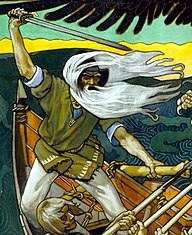
Tolkien'due south biographer Humphrey Carpenter relates that Tolkien owned a postcard entitled Der Berggeist ("the mountain spirit"), which he labelled "the origin of Gandalf".[v] It shows a white-bearded man in a large hat and cloak seated among boulders in a mountain woods. Carpenter said that Tolkien recalled buying the postcard during his vacation in Switzerland in 1911. Manfred Zimmerman, however, discovered that the painting was by the High german artist Josef Madlener and dates from the mid-1920s. Carpenter acknowledged that Tolkien was probably mistaken almost the origin of the postcard.[6] An boosted influence may accept been Väinämöinen, an old and wise demigod and the key graphic symbol in Finnish folklore and the national epic Kalevala by Elias Lönnrot.[7]
Throughout the early on drafts, and through to the first edition of The Hobbit, Bladorthin/Gandalf is described equally being a "piffling onetime human", distinct from a dwarf, merely not of the full human stature that would later be described in The Lord of the Rings. Even in The Lord of the Rings, Gandalf was not tall; shorter, for instance, than Elrond[T 30] or the other wizards.[T 31]
Name [edit]
When writing The Hobbit in the early 1930s Tolkien gave the name Gandalf to the leader of the Dwarves, the character after called Thorin Oakenshield. The name is taken from the same source equally all the other Dwarf names (save Balin) in The Hobbit: the "Catalogue of Dwarves" in the Völuspá.[eight] The Quondam Norse name Gandalfr incorporates the words gandr meaning "wand", "staff" or (especially in compounds) "magic" and álfr "elf". The name Gandalf is institute in at least ane more place in Norse myth, in the semi-historical Heimskringla, which briefly describes Gandalf Alfgeirsson, a legendary Norse king from eastern Norway and rival of Halfdan the Black.[nine] Gandalf is also the name of a Norse sea-king in Henrik Ibsen's second play, The Burial Mound. The proper noun "Gandolf" occurs every bit a graphic symbol in William Morris' 1896 fantasy novel The Well at the Earth'south Terminate, along with the horse "Silverfax", adapted by Tolkien as Gandalf'due south horse "Shadowfax". Morris' book, inspired by Norse myth, is set in a pseudo-medieval landscape; information technology deeply influenced Tolkien. The wizard that became Gandalf was originally named Bladorthin.[10] [11]
Tolkien came to regret his advertisement hoc use of Former Norse names, referring to a "rabble of eddaic-named dwarves, ... invented in an idle hour" in 1937.[T 32] Merely the decision to use Onetime Norse names came to have far-reaching consequences in the composition of The Lord of the Rings; in 1942, Tolkien decided that the work was to exist a purported translation from the fictional language of Westron, and in the English translation One-time Norse names were taken to represent names in the language of Dale.[12] Gandalf, in this setting, is thus a representation in English (anglicised from Old Norse) of the name the Dwarves of Erebor had given to Olórin in the language they used "externally" in their daily affairs, while Tharkûn is the (untranslated) proper name, presumably of the same significant, that the Dwarves gave him in their native Khuzdul linguistic communication.[T 33]
Guide [edit]
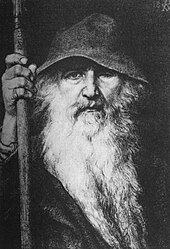

Like Odin in "Wanderer" guise—an former man with a long white beard, a wide brimmed hat, and a staff:[xiii] Gandalf, by 'Nidoart', 2013
Gandalf'south role and importance was substantially increased in the conception of The Lord of the Rings, and in a alphabetic character of 1954, Tolkien refers to Gandalf as an "angel incarnate".[T 34] In the aforementioned letter Tolkien states he was given the form of an one-time man in order to limit his powers on Earth. Both in 1965 and 1971 Tolkien over again refers to Gandalf as an angelic beingness.[T 35] [T 36]
In a 1946 alphabetic character, Tolkien stated that he idea of Gandalf as an "Odinic wanderer".[T 37] Other commentators accept similarly compared Gandalf to the Norse god Odin in his "Wanderer" guise—an old man with ane heart, a long white beard, a wide brimmed chapeau, and a staff,[13] [14] or likened him to Merlin of Arthurian legend or the Jungian archetype of the "wise erstwhile homo".[15]
| Attribute | Gandalf | Odin |
|---|---|---|
| Accoutrements | "dilapidated hat" cloak "thorny staff" | Epithet: "Long-hood" blue cloak a staff |
| Beard | "the grey", "old man" | Epithet: "Greybeard" |
| Appearance | the Istari (Wizards) "in elementary guise, as it were of Men already erstwhile in years just hale in trunk, travellers and wanderers" as Tolkien wrote "a figure of 'the Odinic wanderer'"[T 38] | Epithets: "Wayweary", "Wayfarer", "Wanderer" |
| Ability | with his staff | Epithet: "Bearer of the [Magic] Wand" |
| Eagles | rescued repeatedly past eagles in The Hobbit and Lord of the Rings | Associated with eagles; escapes from Jotunheim back to Asgard every bit an eagle |
The Tolkien scholar Charles West. Nelson described Gandalf as a "guide who .. assists a major grapheme on a journey or quest .. to unusual and distant places". He noted that in both The Fellowship of the Band and The Hobbit, Tolkien presents Gandalf in these terms. Immediately subsequently the Council of Elrond, Gandalf tells the Fellowship:[xvi]
Someone said that intelligence would be needed in the political party. He was right. I call up I shall come with yous.[16]
Nelson notes the similarity between this and Thorin's argument in The Hobbit:[16]
Nosotros shall presently .. get-go on our long journey, a journeying from which some of us, or perhaps all of u.s. (except our friend and counsellor, the ingenious wizard Gandalf) may never return.[sixteen]
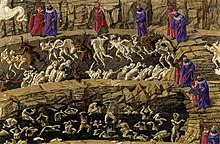
Nelson gives as examples of the guide effigy the Cumaean Sibyl who assisted Aeneas on his journeying through the underworld in Virgil's tale The Aeneid, and and so Virgil himself in Dante's Inferno, directing, encouraging, and physically assisting Dante as he travels through hell. In English language literature, Nelson notes, Thomas Malory's Le Morte d'Arthur has the wizard Merlin instruction and directing Arthur to begin his journeys. Given these precedents, Nelson remarks, it was unsurprising that Tolkien should make use of a guide figure, endowing him, like these predecessors, with ability, wisdom, feel, and applied noesis, and "enlightened[ness] of [his] ain limitations and [his] ranking in the order of the dandy".[16] Other characters who deed as wise and proficient guides include Tom Bombadil, Elrond, Aragorn, Galadriel—who he calls peradventure the most powerful of the guide figures—and briefly also Faramir.[16]
Nelson writes that at that place is equally historical precedent for wicked guides, such every bit Edmund Spenser's "evil palmers" in The Faerie Queene, and suggests that Gollum functions as an evil guide, contrasted with Gandalf, in Lord of the Rings. He notes, too, that both Gollum and Gandalf are servants of The One, Eru Ilúvatar, in the struggle against the forces of darkness, and "ironically" all of them, good and bad, are necessary to the success of the quest.[16]
Christ-effigy [edit]
The critic Anne C. Petty, writing about "Allegory" in the J.R.R. Tolkien Encyclopedia, discusses Gandalf's death and reappearance in Christian terms. She cites Michael W. Maher, South.J.: "who could non think of Gandalf's descent into the pits of Moria and his render clothed in white every bit a death-resurrection motif?"[17] [eighteen] She at in one case notes, however, that "such a narrow [allegorical] interpretation" limits the reader's imagination past enervating a single meaning for each character and effect.[17]
The philosopher Peter Kreeft, like Tolkien a Roman Catholic, observes that there is no ane complete, concrete, visible Christ figure in The Lord of the Rings comparable to Aslan in C. South. Lewis'due south Chronicles of Narnia series. However, Kreeft and Jean Chausse have identified reflections of the figure of Jesus Christ in three protagonists of The Lord of the Rings: Gandalf, Frodo and Aragorn. While Chausse institute "facets of the personality of Jesus" in them, Kreeft wrote that "they exemplify the Former Testament threefold Messianic symbolism of prophet (Gandalf), priest (Frodo), and male monarch (Aragorn)."[19] [20] [21]
| Christ-like attribute | Gandalf | Frodo | Aragorn |
|---|---|---|---|
| Sacrificial death, resurrection | Dies in Moria, reborn every bit Gandalf the White[c] | Symbolically dies under Morgul-knife, healed past Elrond[23] | Takes Paths of the Dead, reappears in Gondor |
| Saviour | All three assist to relieve Middle-world from Sauron | ||
| Threefold Messianic symbolism | Prophet | Priest | Rex |
Adaptations [edit]

In the BBC Radio dramatizations, Gandalf has been voiced by Norman Shelley in The Lord of the Rings (1955–1956),[24] Heron Carvic in The Hobbit (1968), Bernard Mayes in The Lord of the Rings (1979),[25] and Sir Michael Hordern in The Lord of the Rings (1981).[26]
John Huston voiced Gandalf in the blithe films The Hobbit (1977) and The Return of the Male monarch (1980) produced by Rankin/Bass. William Squire voiced Gandalf in the blithe film The Lord of the Rings (1978) directed past Ralph Bakshi. Ivan I. Krasko played Gandalf in the Soviet flick adaptation The Hobbit (1985).[27] Gandalf was portrayed by Vesa Vierikko in the Finnish tv miniseries Hobitit (1993).[28]
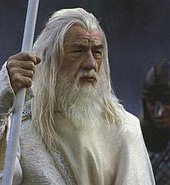
Ian McKellen portrayed Gandalf in The Lord of the Rings film series (2001–2003), directed by Peter Jackson, later Sean Connery and Patrick Stewart both turned downwardly the function.[29] [xxx] According to Jackson, McKellen based his functioning as Gandalf on Tolkien himself:
Nosotros listened to audio recordings of Tolkien reading excerpts from Lord of the Rings. We watched some BBC interviews with him—there'due south a few interviews with Tolkien—and Ian based his performance on an impersonation of Tolkien. He's literally basing Gandalf on Tolkien. He sounds the same, he uses the voice communication patterns and his mannerisms are built-in out of the aforementioned roughness from the footage of Tolkien. Then, Tolkien would recognize himself in Ian'southward operation.[31]
McKellen received widespread acclaim[32] for his portrayal of Gandalf, particularly in The Fellowship of the Ring, for which he received a Screen Actors Club Award[33] and an Academy Award nomination, both for all-time supporting actor.[34] Empire named Gandalf, as portrayed by McKellen, the 30th greatest film graphic symbol of all time.[35] He reprised the part in The Hobbit film series (2012–2014), challenge that he enjoyed playing Gandalf the Grayness more than than Gandalf the White.[36] [37] He voiced Gandalf for several video games based on the films, including The Two Towers,[38] The Return of the Male monarch,[39] and The Tertiary Age.[40]
Charles Picard portrayed Gandalf in the 1999 stage production of The Two Towers at Chicago's Lifeline Theatre.[41] [42] Brent Carver portrayed Gandalf in the 2006 musical production The Lord of the Rings, which opened in Toronto.[43]
Gandalf appears in The Lego Movie, voiced past Todd Hanson.[44] Gandalf is a chief character in the video game Lego Dimensions and is voiced by Tom Kane.[45]
Gandalf has his own movement in Johan de Meij's Symphony No. 1 "The Lord of the Rings", which was written for concert ring and premiered in 1988.[46]
Come across too [edit]
- Secret Fire
- Väinämöinen – Main character in the Finnish national epic Kalevala
Notes [edit]
- ^ Meaning "Grey Pilgrim"
- ^ In Letters, #156, pp. 202–three, Tolkien clearly implies that the "Authority" that sent Gandalf back was to a higher place the Valar (who are bound by Arda's space and time, while Gandalf went beyond time). He clearly intends this every bit an case of Eru intervening to change the course of the world.
- ^ Other commentators such as Jane Chance have compared this transformed reappearance to the Transfiguration of Jesus.[22]
References [edit]
Principal [edit]
-
- This list identifies each item's location in Tolkien's writings.
- ^ a b c d e f g h i j k fifty Unfinished Tales, function iv, ch. 2, "The Istari"
- ^ The Ii Towers, book iv, ch. five, "The Window on the West"
- ^ a b c d The Render of the Rex, Appendix B.
- ^ a b The Silmarillion, "Of the Rings of Ability and the Tertiary Age"
- ^ The Hobbit, ch. i, "An Unexpected Party"
- ^ The Hobbit, ch. 3, "A Short Rest"
- ^ The Hobbit, ch. six, "Out of the Frying-Pan into the Fire"
- ^ The Hobbit, ch. 7, "Queer Lodgings"
- ^ The Hobbit, ch. 17, "The Clouds Burst"
- ^ The Hobbit, ch. 19, "The Last Stage"
- ^ a b c d e f 1000 The Fellowship of the Ring, book ii, ch. 2, "The Council of Elrond"
- ^ The Fellowship of the Ring book 1, ch. 1, "A Long-Expected Party"
- ^ The Fellowship of the Band book 1, ch. 2, "The Shadow of the Past"
- ^ The Fellowship of the Band volume 1, ch. 11, "A Knife in the Nighttime"
- ^ The Fellowship of the Band book 2, ch.3, "The Ring Goes Due south"
- ^ The Fellowship of the Ring volume 2, ch. 4, "A Journey in the Night"
- ^ "The Fellowship of the Ring book two, ch. five, "The Bridge of Khazad-Dum"
- ^ a b The Ii Towers book 3, ch. 5, "The White Passenger"
- ^ The Two Towers volume 3, ch. 6, "The King of the Gilded Hall"
- ^ The Two Towers volume iii, ch. 7, "Helm's Deep"
- ^ The Two Towers book 3, ch. 8, "The Road to Isengard"
- ^ The Two Towers volume 3, ch. x, "The Phonation of Saruman"
- ^ The Two Towers book iii, ch. xi, "The Palantír"
- ^ The Render of the Rex book 5, ch. ane, "Minas Tirith"
- ^ The Return of the King book 5, ch. 10, "The Blackness Gate Opens"
- ^ The Return of the Rex book 6, ch. 4, "The Field of Cormallen"
- ^ The Return of the King book 6, ch. 5, "The Steward and the Male monarch"
- ^ The Return of the King volume vi, ch. 7, "Homeward Leap"
- ^ The Return of the King volume half-dozen, ch. 9, "The Grey Havens"
- ^ The Fellowship of the Ring, book 2, ch. 1, "Many Meetings".
- ^ Unfinished Tales, "The Istari", p. 389.
- ^ The Return of the Shadow, p. 452.
- ^ J. R. R. Tolkien (1967) Guide to the Names in The Lord of the Rings
- ^ Letters, no. 156.
- ^ Letters, no. 268.
- ^ Letters, no. 325.
- ^ Letters, no. 107.
- ^ Letters, no. 119
Secondary [edit]
- ^ Rateliff, John D. (2007). Return to Purse-Terminate. The History of The Hobbit. Vol. 2. HarperCollins. Appendix III. ISBN978-0-00-725066-0.
- ^ Rateliff, John D. (2007). Mr. Baggins. The History of The Hobbit. Vol. 1. HarperCollins. Affiliate I(b). ISBN978-0-00-725066-0.
- ^ Unfinished Tales, office 3, three, "The Quest of Erebor"
- ^ The Hobbit, ch. 2, "Roast Mutton"
- ^ Carpenter, Humphrey (1977). J.R.R. Tolkien: a biography. Allen & Unwin. p. 51. ISBN9780049280373.
- ^ Zimmerman, Manfred (1983). "The Origin of Gandalf and Josef Madlener". Mythlore. Mythopoeic Social club. 9 (4).
- ^ Snodgrass, Ellen (2009). "Kalevala (Elias Lönnrot) (1836)". Encyclopedia of the Literature of Empire. Infobase Publishing. pp. 161–162. ISBN9781438119069.
- ^ Solopova, Elizabeth (2009), Languages, Myths and History: An Introduction to the Linguistic and Literary Background of J. R. R. Tolkien'due south Fiction, New York City: North Landing Books, p. 20, ISBN 978-0-9816607-1-four
- ^ "Halfdan the Blackness Saga (Ch. 1. Halfdan Fights Gandalf and Sigtryg) in Snorri Sturluson, Heimskringla: A History of the Norse Kings, transl. Samuel Laing (Norroena Society, London, 1907)". mcllibrary.org. Retrieved 22 March 2018.
The same autumn he went with an army to Vingulmark confronting King Gandalf. They had many battles, and sometimes one, sometimes the other gained the victory; but at last they agreed that Halfdan should take half of Vingulmark, as his begetter Gudrod had had it before.
- ^ Anderson, Douglas A., ed. (1988). "Inside Information". The Annotated Hobbit. Allen & Unwin. p. 287.
- ^ Rateliff, John D. (2007). "Introduction". The History of the Hobbit, Office one: Mr. Baggins. Houghton Mifflin Harcourt. p. ix. ISBN978-0618968473.
- ^ Shippey, Tom. "Tolkien and Iceland: The Philology of Envy". Nordals.hi.is. Archived from the original on 30 August 2005. Retrieved eleven Nov 2012.
Nosotros know that Tolkien had slap-up difficulty in getting his story going. In my opinion, he did not break through until, on February 9, 1942, he settled the issue of languages
- ^ a b Jøn, A. Asbjørn (1997). An investigation of the Teutonic god Óðinn; and a study of his relationship to J. R.R. Tolkien's character, Gandalf (Thesis). Academy of New England.
- ^ a b Burns, Marjorie (2005). Perilous Realms: Celtic and Norse in Tolkien's Middle-earth. University of Toronto Press. pp. 95–101. ISBN0-8020-3806-9.
- ^ Lobdell, Jared (1975). A Tolkien Compass. Open Court Publishing. p. 33. ISBN0-87548-303-8.
- ^ a b c d e f g h Nelson, Charles W. (2002). "From Gollum to Gandalf: The Guide Figures in J. R. R. Tolkien'southward "Lord of the Rings"". Journal of the Fantastic in the Arts. xiii (ane): 47–61. JSTOR 43308562.
- ^ a b Petty, Anne C. (2013) [2007]. "Allegory". In Drout, Michael D. C. (ed.). J.R.R. Tolkien Encyclopedia: Scholarship and Critical Assessment. Routledge. pp. 6–7. ISBN978-0-415-86511-i.
- ^ Maher, Michael W. (2003). Take chances, Jane (ed.). 'A land without stain': medieval images of Mary and their use in the label of Galadriel. Tolkien the Medievalist. Routledge. p. 225.
- ^ a b Kreeft, Peter J. (November 2005). "The Presence of Christ in The Lord of the Rings". Ignatius Insight.
- ^ Kerry, Paul E. (2010). Kerry, Paul Due east. (ed.). The Band and the Cantankerous: Christianity and the Lord of the Rings. Fairleigh Dickinson University Press. pp. 32–34. ISBN978-ane-61147-065-9.
- ^ Schultz, Forrest West. (one December 2002). "Christian Typologies in The Lord of the Rings". Chalcedon. Retrieved 26 March 2020.
- ^ Nitzsche, Jane Chance (1980) [1979]. Tolkien's Art. Papermac. p. 42. ISBN0-333-29034-eight.
- ^ Also by other commentators, such every bit Mathews, Richard (2016). Fantasy: The Liberation of Imagination. Routledge. p. 69. ISBN978-one-136-78554-2.
- ^ "Norman Shelley". Tolkien Gateway . Retrieved 5 April 2020.
- ^ "Mind'south Eye The Lord of the Rings (1979)". SF World. 31 August 2014. Retrieved 5 April 2020.
- ^ "The Lord of the Rings BBC Adaptation (1981)". SF World. 31 Baronial 2014. Retrieved v April 2020.
- ^ "'The Hobbit': Russian Soviet Version Is Inexpensive / Delightful". Huffington Postal service. New York Metropolis. 21 December 2011. Retrieved thirty September 2012.
- ^ Kajava, Jukka (29 March 1993). "Tolkienin taruista on tehty tv-sarja: Hobitien ilme syntyi jo Ryhmäteatterin Suomenlinnan tulkinnassa" [Tolkien's tales have been turned into a TV serial: The Hobbits accept been brought to live in the Ryhmäteatteri theatre]. Helsingin Sanomat (in Finnish). (subscription required)
- ^ Saney, Daniel (1 August 2005). "'Idiots' force Connery to quit acting". Digital Spy. Hearst Magazines UK. Retrieved 2 February 2011.
- ^ "New York Con Reports, Pictures and Video". TrekMovie. 9 March 2008. Retrieved 12 March 2008.
- ^ Ryan, Mike (6 Dec 2012). "Peter Jackson, 'The Hobbit' Managing director, On Returning To Middle-Earth & The Polarizing 48 FPS Format". The Huffington Postal service. New York City: Huffington Post Media Group. Retrieved 12 August 2013.
- ^ Moore, Sam (23 March 2017). "Sir Ian McKellen to reprise office of Gandalf in new one-human show". NME. Retrieved 18 April 2020.
- ^ "Acting Awards, Honours, and Appointments". Ian McKellen. Retrieved 18 Apr 2020.
- ^ "The 74th University Awards (2002) Nominees and Winners". oscars.org . Retrieved 19 November 2011.
- ^ "The 100 Greatest Film Characters: 30. Gandalf". Empire. London, England: Bauer Media Grouping. 29 June 2015. Retrieved 9 June 2018.
- ^ Sibley, Brian (2006). "Ring-Chief". Peter Jackson: A Film-maker'southward Journeying. HarperCollins. pp. 445–519. ISBN0-00-717558-2.
- ^ "Ian McKellen as Gandalf in The Hobbit". Ian McKellen. Archived from the original on 3 July 2011. Retrieved 11 January 2011.
- ^ "Gandalf". Behind the Voice Actors . Retrieved 22 Jan 2021.
- ^ "Gandalf". Behind the Vocalisation Actors . Retrieved 22 January 2021.
- ^ "Gandalf". Behind the Voice Actors . Retrieved 22 Jan 2021.
- ^ "TheOneRing.net™ | Events | World Events | The Two Towers at Chicago'southward Lifeline Theatre". archives.theonering.internet . Retrieved i April 2020.
- ^ Wren, Celia (October 2001). "The Mordor the Merrier". American Theatre. 18: 13–15.
- ^ Jones, Kenneth (25 July 2005). "Precious News! Tony Award Winner Volition Play Gandalf in Lord of the Rings Musical; Cast Appear". Playbill. Playbill. Retrieved 28 March 2013.
- ^ "Gandalf". Behind the Vocalization Actors . Retrieved 19 Apr 2020.
Todd Hansen is the voice of Gandalf in The LEGO Picture.
- ^ Lang, Derrick (nine Apr 2015). "Awesome! 'Lego Dimensions' combining bricks and franchises". The Denver Mail service. Denver, Colorado: Digital Get-go Media. Archived from the original on iv September 2015. Retrieved 9 April 2015.
- ^ "Der Herr der Ringe, Johan de Meij - Sinfonie Nr.one". Archived from the original on 11 October 2014. Retrieved 21 October 2021.
Source: https://en.wikipedia.org/wiki/Gandalf
0 Response to "Roads to Madness Lord of the Rings Art Drawings"
Enregistrer un commentaire